Most form tools treat submit as the finish line.
A person fills fields. A request is sent. A row appears somewhere. Maybe an email notification goes out. The product has done its job.
We think that view is backwards.
Submit is not the end of the workflow. Submit is the moment the workflow becomes possible.
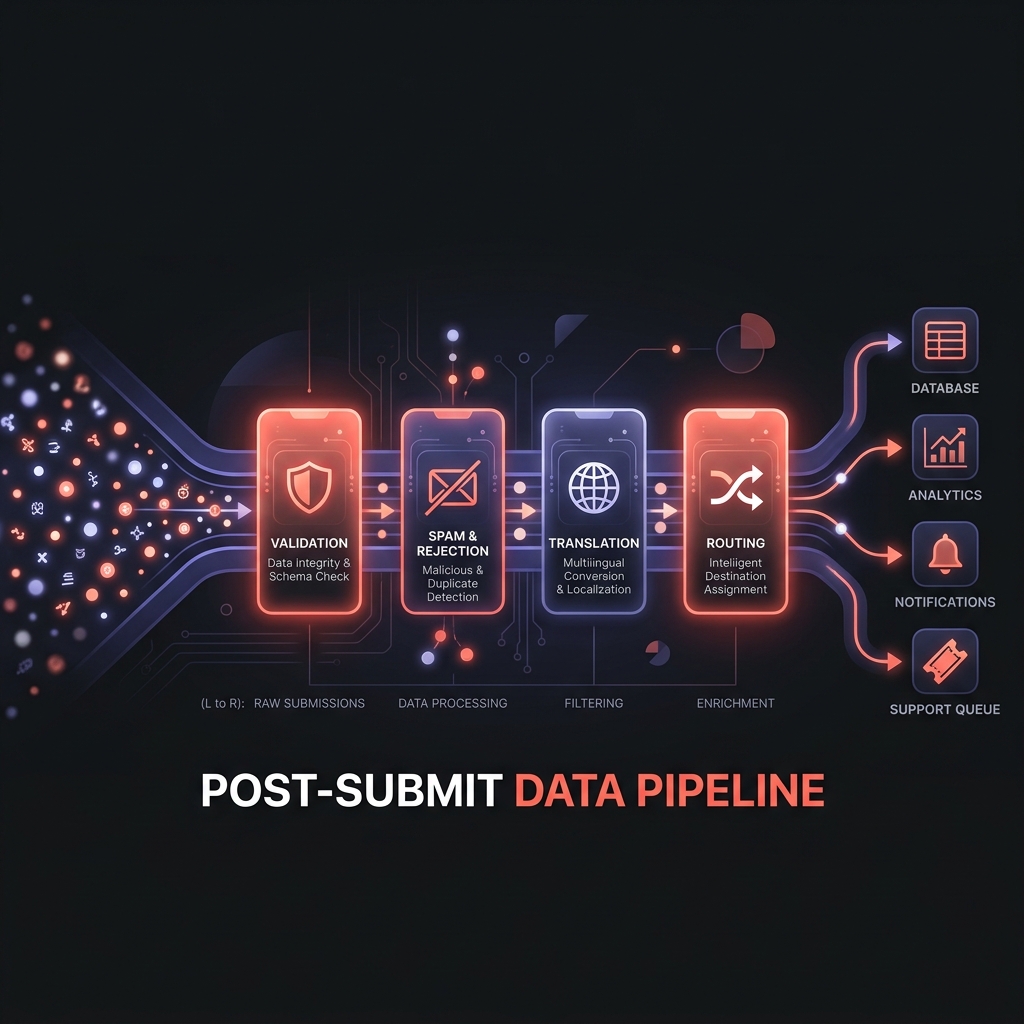
Everything valuable happens after that: validation, spam filtering, translation, reply drafting, routing, summarization, escalation, notification, analysis. The form is just the front door. The post-submit pipeline is the house.
Raw submissions are not the goal
A raw submission is only useful if the data can be trusted and acted on.
If the email field contains not-an-email, someone has to clean it. If the message is crypto spam, someone has to ignore it. If the user writes in Spanish and your support team works in English, someone has to translate it. If the question has an obvious answer in your docs, someone has to write the same reply again. If the submission belongs in Slack, Discord, a CRM, and your own backend, someone has to route it.
Teams build this machinery over and over. Usually in fragments. A little validation in the frontend. A backend handler. A spam check. A webhook retry loop. A notification formatter. A script to export data. A half-finished admin view. A queue. A cron job. A spreadsheet.
None of it is glamorous. All of it matters.
Postbox exists because the work after submit is too important to keep rebuilding casually.
Stage one: validation
Validation is the boundary between data and noise.
The schema says what the form accepts. Postbox enforces it at the endpoint. Types, required fields, patterns, ranges, enum values — the contract is checked before the submission is allowed to land.
This matters because downstream systems tend to assume data is real. A CRM does not want malformed email addresses. A support workflow does not want missing categories. An agent summarizing feedback does not want to reason over broken payloads.
Good validation is not just about rejecting bad input. It is about preserving trust in everything that happens later.
Stage two: spam filtering
Spam is not one problem.
Some spam is mechanical: bots filling every field, repeated requests, obvious junk. Standard heuristics and honeypots catch a lot of that cheaply.
Some spam is semantic: a message that looks syntactically valid but has nothing to do with the form’s intent. A crypto pitch on a product feedback form. SEO outreach in a support channel. A sales solicitation disguised as a bug report.
That is where intelligent spam detection helps. The form’s intent gives the model context. It can judge whether a submission belongs, not just whether it contains suspicious words.
The goal is not to make an inbox empty. The goal is to make the inbox worth reading.
Stage three: translation
The internet does not submit in one language.
A contact form on an English site can still receive Spanish, French, Hindi, Japanese, or Portuguese. If the data is valuable, language should not be the reason it waits unread.
Postbox can detect language and translate submissions on the way in while preserving the original. That last part matters. Translation is a working copy, not a replacement. The original text remains available for nuance, audit, and follow-up.
For global products, translation is not a novelty. It is a way to keep one inbox instead of silently privileging one language.
Stage four: smart replies
Some questions require judgment. Many do not.
“Do you offer nonprofit discounts?” “Where do I find invoices?” “Does this work with Slack?” “How do I reset my API key?”
Teams answer these questions repeatedly because the data arrives as a message, not as an action. Postbox changes that by connecting forms to a knowledge base. When a submission arrives, the system can draft a context-aware reply from your own material.
Draft mode keeps a human in the loop. Auto mode can send when the answer is safe enough and the form has an email field. Either way, the repetitive part of support becomes less repetitive.
The point is not to impersonate a human. It is to stop wasting human attention on answers the system already knows.
Stage five: routing
Clean data still needs to go somewhere.
A lead belongs in a sales channel. A bug report belongs with engineering. A security report should not sit in a general inbox. A vendor onboarding form might need to hit an internal backend and notify operations.
Routing is where form data becomes workflow data.
Postbox destinations send processed submissions to webhooks, Discord, and Slack. Webhooks include signed payloads so your systems can verify authenticity. Notifications carry the useful parts of the submission, not just “someone submitted a form.”
Routing is not an afterthought. It is how data leaves the collection layer and enters the systems that actually do the work.
Why async matters
The submitter should not wait for all of this.
Validation needs to happen immediately because it decides whether the submission is accepted. But spam analysis, translation, smart reply generation, and notifications can run after the 201 response. The person submitting the form gets a fast answer. The pipeline keeps working in the background.
That separation is important. A form endpoint should feel instant without reducing the quality of what happens next.
The pipeline is configurable
Not every form needs every stage.
A private internal request form might need validation and routing, but no spam filtering. A public contact form might need spam detection and smart replies. A global feedback form might need translation. A high-volume waitlist might only need validation and a webhook.
Postbox treats the pipeline as form-level configuration. The contract defines what can arrive. The pipeline defines what happens after it arrives.
The product after submit
The visible form gets too much credit.
It is the part people see, so it feels like the product. But from the owner’s point of view, the value is not in pixels. It is in receiving clean, useful, routed, understandable data without building the machinery yourself.
That is why we say the post-submit pipeline is the product.
The endpoint is the front door. The schema is the contract. The pipeline is where the work happens.
If your form backend stops at storage, you still have most of the system left to build.
Explore the full Postbox feature pipeline, or use the pricing calculator to estimate AI features like spam detection, translation, and smart replies.